Concept


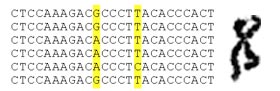
Work on cytology in the late 1800s had shown that each living thing has a characteristic set of chromosomes in the nucleus of each cell. During the same period, biochemical studies indicated that the nuclear material that makes up the chromosomes is composed of DNA and proteins. In the first four decades of the 20th century, many scientists believed that protein carried the genetic code, and DNA was merely a supporting "scaffold." Just the opposite proved to be true. Work by Avery and Hershey, in the 1940s and 1950s, proved that DNA is the genetic molecule. Work done in the 1960s and 1970s showed that each chromosome is essentially a package for one very long, continuous strand of the DNA. In higher organisms, structural proteins, some of which are histones, provide a scaffold upon which DNA is built into a compact chromosome. The DNA strand is wound around histone cores, which, in turn, are looped and fixed to specific regions of the chromosome.

Animation


Hi, I’m Stan Rupert. In the 1950’s I got tired of doing physics and became interested in molecular biology. I started working with Solomon Goodgal at Johns Hopkins. Goodgal had heard about Albert Kelner’s work that showed a fungal cell culture could mysteriously recover from apparent death by ultraviolet radiation. Kelner found that the cells only recovered when they were exposed to visible light. Placing culture samples from the light and dark treatments on culture plates showed that only the cells exposed to light could recover and grow. At the time, people thought that light destroyed "cellular poisons" created by the UV irradiation. Goodgal and I thought that cells recovered because light helped repair DNA damaged by UV. We tested our idea by measuring the "transformation" of Hemophilus influenzae bacteria. Transformation occurs when a bacterium grabs extracellular DNA, brings it through the cell wall, and integrates it into its own genome. The cell on the right has just been transformed with a piece of DNA containing a gene for antibiotic resistance, signified by the yellow circle. The transformed cell will express this new gene and survive when exposed to the streptomycin antibiotic. Using this gene for antibiotic resistance, we can determine which cells have been transformed by growing the cells on culture plates containing the streptomycin antibiotic. Transformed cells will be resistant to streptomycin and form colonies on the plate; cells that weren't transformed will die. We used this system to show that UV damaged DNA. We isolated DNA from a streptomycin-resistant strain of Hemophilus influenzae bacteria, irradiated one sample with UV, and used the second as a control. After putting the DNA into cultures of Hemophilus cells, we cultured the cells on streptomycin plates to look for transformants. Cells from the control culture received a working streptomycin gene and formed many colonies on the plate. However, few cells grew from the UV culture, we thought this must be because UV had damaged the streptomycin gene. But we had to rule out two other possibilities. The lack of growth in the UV culture could have been caused by something in solvent that, after being altered by UV, prevented transformation. But we found this wasn’t possible, because normal DNA put into UV-irradiated solvent did not show any loss in transforming activity. The other possibility was that the UV-irradiated DNA did not integrate into the Hemophilus genome like unexposed DNA. This would have given us the same results, but for a different reason than our hypothesis. Instead of dying due to DNA damage, cells would have died because they never received the streptomycin resistance gene. But we showed that UV-irradiated DNA is just as likely to integrate into the Hemophilus genome as normal DNA. We were left with the conclusion that the UV damaged the DNA and the streptomycin gene, though we didn’t know how. We then devised an experiment to test our theory that light helped repair the damaged DNA. We mixed the UV-damaged DNA with an extract from E. coli cells, and exposed one tube to light and one to dark. We hypothesized that light activated an enzyme in the E. coli extract, and the activated enzyme repaired the DNA damage. After several minutes, we removed the Hemophilus DNA from the E. coli extract and added it to a culture of streptomycin-susceptible Hemophilus cells. If repaired, the DNA should transform these cells into streptomycin-resistant cells. We found transformed cells in the light cultures, showing that a light-activated enzyme in E. coli fixes UV-damaged DNA. We had found the first known DNA repair system! Unfortunately for us, the enzyme responsible for the repair was present in so few copies we never isolated it. It was eventually identified 27 years later. Additional research showed that this enzyme – photolyase – repairs a specific type of DNA damage called thymine dimers. The dimers are damaging because they stop DNA replication. Dimers form when two adjacent thymines bind to each other instead ot their complementary bases. UV light causes the dimers to form. Photolyase attaches to the dimer and breaks the thymine-thymine bond with energy from light. Not all organisms use photolyase to fix dimers. Richard Setlow and Bill Carrier discovered another system, called excision repair, that removes the dimer by removing a segment of the strand. The size of the segment depends on the organism. After the segment is removed, DNA polymerase fills in the empty space. DNA replication can also introduce errors to DNA. These errors are usually caught by the proofreading ability of the DNA polymerases. If the wrong base is incorporated, DNA polymerase stops and removes the base before continuing replication. Several other repair systems exist to repair errors that slip past the proofreader, as well as other types of damage besides dimers. DNA repair is an integral part of an organism's well-being.

Gallery


Roger Herriott, Stan Rupert and Sol Goodgal at Johns Hopkins (1st row; 3rd, 2nd, and 1st from right).
A researcher in Herriott's lab works in the dark.

Audio/Video


Audio Glossary

Base pair, Deletion, Insertion, Mutation, Recessive, Dominant

Video Interviews

Richard Setlow

Richard Setlow is a Senior Biophysicist at the Brookhaven National Laboratory. Dr. Setlow did some of the early work on DNA repair.

Clip 1 (1:06)
Description of the first experiment done by the Setlows on the effects of UV irradiation on DNA.

Clip 2 (0:37)
Where are the thymine dimers in the bacterial strains?

Clip 3 (1:26)
Isolating thymine dimers from the bacterial strains.

Clip 4 (1:21)
The need for a good mutation repair system.

Jane Setlow

Jane Setlow is Senior Geneticist Emeritus at Brookhaven National Laboratory. Dr. Setlow did some of the early work on DNA repair.

Clip 1 (0:31)
The significance of understanding mutation repair systems.

Clip 2 (0:19)
The effects of ionizing radiation.

Biography


Claud Rupert did seminal research on light-activated DNA repair systems. Richard Setlow did a lot of the early work on thymine dimer repair.

CLAUD S. RUPERT (1919-)

Claud S. (Stan) Rupert was born in California in 1919 and grew up in a small farming town in the Central Valley. His father managed the local bank and his mother was a homemaker.

Rupert's mother's child-rearing skills included kicking him out of the house when he was moping. One day his mother ordered him to go to the library and get a book on astronomy. Rupert remembers the book was "kinda interesting" and reading it coincided with a total eclipse of the sun on April 28, 1930. Rupert decided to become an astronomer and a space traveler. In preparation for his imagined trips to Mars and Jupiter, Rupert wisely considered his food supply and calculated how many pounds of beans he would need to survive the trip.

In high school, a favorite science teacher gave Rupert extra projects to do, and he started playing with a refraction grating and spectroscopy. He continued to study physics in college at Caltech, although one year he got distracted with editing the school newspaper and failed a physics class. Thomas Hunt Morgan taught his only college biology class.

After retaking the physics class and graduating a bit behind schedule, Rupert worked for Lockheed while he decided what to do with the rest of his life. Airplane design wasn't it, though, and he thought engineering was "too organized. There was room for creativity but not my kind of creativity."

With World War II starting, Rupert had to contain his creativity for a while and he entered the Navy where he helped evaluate new radio and radar gear installed on ships. In the summer of 1946, Rupert left the Navy and started graduate school in physics at Johns Hopkins with money from the G.I. Bill. (Rupert had wanted to return to Caltech, but they were unable to get over that failed physics class.)

Rupert worked with John Strong on infrared spectroscopy for his Ph.D. research. He got hooked on biology when some people from the biology department approached him for help with a project on the effect of infrared light on flowers. Later, Roger Herriott and Sol Goodgal seduced him into their transformation lab where Goodgal came up with an idea to show that enzymes activated by visible light repaired damage to DNA.

Rupert attributes the success of that first experiment to luck. "Everything just happened to work. I made a mistake in getting competent cells and got ten times as many transformants, so that became the standard procedure."

Rupert continued to work on light-activated DNA repair for much of his career at the University of Texas at Dallas, where he moved after Johns Hopkins. His graduate student, Aziz Sancar, successfully purified and described the repair enzyme in the 1980s.

In 1989 Rupert retired from research and briefly became vice president for academic affairs before fully retiring. In his spare time, he and his wife enjoy the theater and the symphony and volunteer to hold long-term care infants at the local hospital.

RICHARD B. SETLOW (1921-)

Richard Setlow was born in 1921 and grew up in the Bronx. Good grades in school qualified him for entrance into the Townsend Harris High School, which was later closed down by Mayor LaGuardia for elitism. He went to Swarthmore College with an interest in science and encountered an exceptional physics instructor. "So I became a physicist because you could explain things so beautifully," Setlow says.

After graduating from college in 1941, Setlow went to Yale to continue his study of physics. "There was a biophysics group being started in the physics department, and I thought that would be a lot of fun," Setlow recalls. "We spent a lot of time irradiating proteins and viruses and cells with ionizing radiation and with ultraviolet radiation."

Setlow received his Ph.D. in physics in 1947 and continued teaching physics and biophysics at Yale until 1961 when he left for the Oak Ridge National Laboratory because he "wanted to have more time for research because it was so much fun."

He first became interested in DNA repair mechanisms when someone at Oak Ridge asked him, " 'Hey Dick, what do you know about these crazy Dutchmen that are irradiating frozen solutions of thymine', and I had to confess I didn't know anything."

After researching the papers of the crazy Dutchmen, Setlow decided their conclusion -- that the thymine dimers they broke with UV irradiation was the same as cellular photoreactivation -- was wrong and set out to solve the problem. In 1964, he and his colleagues showed that bacterial cells repair thymine dimers with enzymes that remove the dimer and replace it with undamaged bases.

In 1974, Setlow moved to the Brookhaven National Laboratory(BNL) where he is still active in DNA repair and ultraviolet radiation research. In the 1990s, using a special hybrid fish sensitive to ultraviolet light, Setlow's team found that UV-A rays cause most melanomas, not UV-B rays that were previously thought responsible.

Because of his finding, Setlow thinks the large increase in melanoma incidence is not due to a thinning ozone layer, which only filters out UV-B rays. "My feeling is that the big increase in malignant melonoma comes about because of lifestyle changes," he says. People use sunblock to stay out longer in the sun, but sunblocks -- even those that claim to block UV-A -- "do not screen out the wavelengths that are probably inducing melanoma."

In 1998, Setlow retired from his administrative duties at BNL as the Associate Director for Life Sciences to devote more time to his research. Setlow also enjoys music, hiking, and volunteering at a camp for handicapped persons.

Among his many awards, Setlow was elected to the National Academy of Sciences in 1973, and became a Fellow of the American Association for the Advancement of Science in 1988.

Factoid

Links


Links

Xeroderma Pigmentosum Society

These pages provide information about this genetic disorder caused by a malfunctional DNA repair enzyme.

Bibliography

  • Friedberg, Errol C., 1997, Correcting the Blueprint of Life: An Historical Account of the Discovery of DNA Repair Mechanisms, Cold Spring Harbor Laboratory Press, Cold Spring Harbor.

  • Rupert, Claud S., Goodgal, Sol H., and Herriott, Roger M., 1958, Photoreactivation in vitro of Ultraviolet Inactivated Hemophilus influenzae Transforming Factor, Journal of General Physiology, 41: 451-471.

  • Setlow, Richard B., 1997, DNA Damage and Repair: A Photobiological Odyssey, Photochemistry and Photobiology, 65S: 119S-122S.

  • Snustad, D. Peter, Simmons, Michael J., and Jenkins, John B., 1997, Principles of Genetics, John Wiley & Sons, Inc., New York.

Glossary


Base pair - Two bases which form a "rung of the DNA ladder." A DNA nucleotide is made of a molecule of sugar, a molecule of phosphoric acid, and a molecule called a base. The bases are the "letters" that spell out the genetic code. In DNA, the code letters are A, T, G, and C, which stand for the chemicals adenine, thymine, guanine, and cytosine, respectively. In base pairing, adenine always pairs with thymine, and guanine always pairs with cytosine.
Deletion - A particular kind of mutation: loss of a piece of DNA from a chromosome. Deletion of a gene or part of a gene can lead to a disease or abnormality.
Insertion - A type of chromosomal abnormality in which a DNA sequence is inserted into a gene, disrupting the normal structure and function of that gene.
Mutation - A permanent structural alteration in DNA. In most cases, such DNA changes either have no effect or cause harm, but occasionally a mutation can improve an organism's chance of surviving and passing the beneficial change on to its descendants.
Recessive - A genetic disorder that appears only in patients who have received two copies of a mutant gene, one from each parent.
Dominant - A gene that almost always results in a specific physical characteristic, for example, a disease, even though the patient's genome possesses only one copy. With a dominant gene, the chance of passing on the gene (and therefore the disease) to children is 50-50 in each pregnancy.

Children resemble their parents.
Genes come in pairs.
Genes don't blend.
Some genes are dominant.
Genetic inheritance follows rules.
Genes are real things.
All cells arise from pre-existing cells.
Sex cells have one set of chromosomes; body cells have two.
Specialized chromosomes determine gender.
Chromosomes carry genes.
Genes get shuffled when chromosomes exchange pieces.
Evolution begins with the inheritance of gene variation.
Mendelian laws apply to human beings.
Mendelian genetics cannot fully explain human health and behavior.

DNA and proteins are the molecules of the cell nucleus.
One gene makes one protein.
A gene is made of DNA.
Bacteria and viruses have DNA too.
The DNA molecule is shaped like a twisted ladder.
A half DNA ladder is a template for copying the whole.
RNA is an intermediary between DNA and protein.
DNA words are three letters long.
A gene is a discrete sequence of DNA nucleotides.
The RNA message is sometimes edited.
Some viruses store genetic information in RNA.
RNA was the first genetic molecule.
Mutations are changes in genetic information.
A chromosome is a package for DNA.
Higher cells incorporate an ancient chromosome.
Some DNA does not encode protein.
Some DNA can jump.
Genes can be turned on and off.
Genes can be moved between species.
DNA responds to signals from outside the cell.
Different genes are active in different kinds of cells.
Master genes control basic body plans.
Development balances cell growth and death.
A genome is an entire set of genes.
Living things share common genes.
DNA is only the starting point for understanding human biology.
adi_at_dnaftb