 Children resemble their parents.
 Genes come in pairs.
 Genes don't blend.
 Some genes are dominant.
 Genetic inheritance follows rules.
 Genes are real things.
 All cells arise from pre-existing cells.
 Sex cells have one set of chromosomes; body cells have two.
 Specialized chromosomes determine sex.
 Chromosomes carry genes.
 Genes get shuffled when chromosomes exchange pieces.
 Evolution begins with the inheritance of gene variations.
 Mendelian laws apply to human beings.
 Mendelian genetics cannot fully explain human health and behavior.
 DNA and proteins are key molecules of the cell
nucleus.
DNA and proteins are key molecules of the cell
nucleus. One gene makes one protein.
 A gene is made of DNA.
 Bacteria and viruses have DNA too.
 The DNA molecule is shaped like a twisted ladder.
 A half DNA ladder is a template for copying the
whole.
A half DNA ladder is a template for copying the
whole. RNA is an intermediary between DNA and protein.
 DNA words are three letters long.
 A gene is a discrete sequence of DNA nucleotides.
 The RNA message is sometimes edited.
 Some viruses store genetic information in RNA.
 RNA was the first genetic molecule.
 Mutations are changes in genetic information.
 Some types of mutations are automatically repaired.
 DNA is packaged in a chromosome.
 Higher cells incorporate an ancient chromosome.
 Some DNA does not encode protein.
 Some DNA can jump.
 Genes can be turned on and off.
 Genes can be moved between species.
 DNA responds to signals from outside the cell.
 Different genes are active in different kinds of
cells.
Different genes are active in different kinds of
cells. Master genes control basic body plans.
 Development balances cell growth and death.
 A genome is an entire set of genes.
 Living things share common genes.
 DNA
is only the beginning for understanding the human genome.
DNA
is only the beginning for understanding the human genome.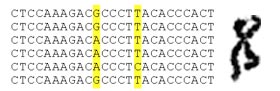
DNA from the Beginning is organized around key concepts.
The science behind each concept is explained by:
animation, image gallery, video interviews, problem, biographies, and links.
- About the DNA Learning Center
- Since the DNA Learning Center was established in 1988, we've been advancing genetics education for students and families. We deliver biotechnology instruction through laboratory field trips, summer camps, and independent research programs for students in New York and beyond. More than 750,000 middle and high school students have experienced our hands-on approach to science instruction over the last 35+ years. We also offer up-to-date teacher training through biology workshops and professional development for teachers in genetics and biotechnology.
- Find the DNALC on:
-