Concept 27 Mutations are changes in genetic information.

 Hermann Muller received the 1946 Nobel Prize in Physiology or Medicine for his work on mutations induced by X-rays. Seymour Benzer used genetics to prove that mutations were caused by changes in the DNA sequence.
- Go to:
- Seymour Benzer (1921-2007)
Hermann Muller (1890-1967)
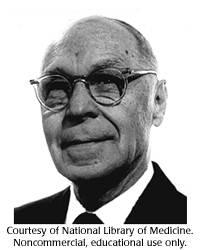
Hermann Muller was born in Manhattan in 1890 and grew into a 5'2" science geek. His father, who casted statues at Muller Art Metal Works, influenced Hermann with his socialist ideals and a love of science. As a boy, Hermann spent summers hiking in the Adirondack Mountains and spent nights pondering how life would be on the planets he viewed through his telescope.
Upon graduation from Morris High School in 1907 at age sixteen, Muller attended Columbia University and was attracted to the emerging field of genetics.
He remained at Columbia for graduate school where he spent time in T.H. Morgan's Drosophila lab. Muller joined Morgan's other students in stealing small milk bottles from apartment steps to house the flies. But Muller clashed with Morgan and his student, Alfred Sturtevant, because Muller felt that they did not fully acknowledge his ideas in their papers.
Consequently, Muller appears on few papers that came from the Fly Lab except his own. In one paper, Muller showed that mutations in one gene could alter the expression of another gene, implying that many fly characteristics depend on several interacting genes. He left the lab in 1915 after receiving his degree and eventually joined the faculty at the University of Texas.
In the 1920s, Muller performed his Nobel prize-winning research showing that X-rays could induce mutations and he became instantly famous. Muller used his fame to caution against the indiscriminate use of X-rays in medicine, but despite his warnings, some physicians even prescribed X-rays to stimulate ovulation in sterile women. His warnings angered many doctors and were largely ignored.
Muller's outspoken views on socialism also got him in trouble with the Texas administration. He helped publish a Communist newspaper at the school, and the FBI tracked his activities. Feeling that U.S. society was regressing during the Depression, Muller left for Europe in 1932.
A move to the Soviet Union in 1934 seemed to have cured Muller of his Communist sympathies, although he always remained a socialist. Initially happy with the progressive society, he wrote popular articles praising the friendly people and the initiative of collective farm workers. But he grew unhappy as Stalin's police state attacked genetics by pushing Lamarkian ideas of evolution. The state dictated who could work in his lab and questioned him for referring to the work of Germans or Russian emigrés. By the time he left in 1937, several of his students and colleagues had "disappeared" or been shipped to Siberia.
Muller spent eight weeks in Spain helping the International Brigade develop a way to get blood for transfusions from recently killed soldiers, and then worked at the University of Edinburgh where he continued to work on X-rays and other mutagens like UV and mustard gas.
World War II forced Muller to leave Scotland in 1940 and he eventually found a permanent position at Indiana University in 1945. A year later, Muller won the Nobel Prize for his work on mutation-inducing X-rays and he used the opportunity to continue pressing for more public knowledge about the hazards of X-ray radiation.
Throughout his career, Muller felt scientists should get involved in educating the public. Not only was he outspoken about the effects of radiation, he also fought against the Texas school board's attacks on evolution. He promoted his view of eugenics - though he criticized the American eugenics movement for its racism and classism - and recommended voluntary reproduction through artificial insemination for families with genetic disorders.
Muller died in 1967 of congestive heart failure.


All "golden delicious" apples derive from a mutant branch of a single "red delicious" apple tree.

90% of known cancer-causing chemicals are also mutagens. How do you think these chemicals cause cancer?
 DNA and proteins are key molecules of the cell nucleus.
 One gene makes one protein.
 A gene is made of DNA.
 Bacteria and viruses have DNA too.
 The DNA molecule is shaped like a twisted ladder.
 A half DNA ladder is a template for copying the whole.
 RNA is an intermediary between DNA and protein.
 DNA words are three letters long.
 A gene is a discrete sequence of DNA nucleotides.
 The RNA message is sometimes edited.
 Some viruses store genetic information in RNA.
 RNA was the first genetic molecule.
 Mutations are changes in genetic information.
 Some types of mutations are automatically repaired.