Concept 21 RNA is an intermediary between DNA and protein.


 Paul Zamecnik developed a cell-free extract that he and Mahlon Hoagland used to study protein synthesis. They identified tRNA as the adaptor predicted by Francis Crick in his Central Dogma. Sydney Brenner showed that mRNA was the unstable intermediate that carried the message from DNA to the ribosomes.
Paul Charles Zamecnik (1913-2009)
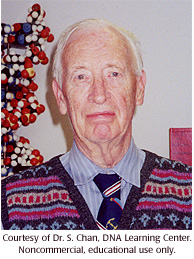
Paul Zamecnik was born in Cleveland, Ohio. He went to Dartmouth College and graduated from Dartmouth Medical School in 1934. Although he trained to be a medical doctor, Zamecnik was always interested in science. He eventually decided to go into research because there was so much to discover. His interest in protein synthesis started with a question. In 1938, as an intern, Zamecnik was doing an autopsy on an obese woman. He wondered why there was fat when there should have been protein and muscle ? no one knew the answer.
In 1939, Zamecnik approached Max Bergmann, a protein chemist at the Rockefeller Institute. He was hoping to get a job in Bergmann's lab so he could work on the problem of protein synthesis. Bergmann turned him down because Zamecnik was an M.D, not a Ph.D.
Zamecnik did get a fellowship to work with Kaj Linderstrøm-Lang at the Carlsberg Laboratory in Denmark. Linderstrøm-Lang was a leader in the field of protein chemistry and Zamecnik obtained enough training and experience that Bergmann gave him a job when he came back to the States.
Zamecnik didn't stay at the Rockefeller for long. He was offered a job at the Huntington Laboratory at the Massachusetts General Hospital in Boston. Here, he worked with Fritz Lipmann (1953 Nobel laureate) and used radioactive isotopes to prove that proteins were built from amino acids in a process requiring chemical energy ? ATP. Zamecnik then became interested in how protein sequences were specified and to understand that he tried to isolate and identify all the components necessary for protein synthesis.
In 1952, Zamecnik was partially successful in that he made a cell-free extract from rat liver with which he was able to synthesize proteins from amino acids. In 1953, using this system, Zamecnik and Mahlon Hoagland showed that amino acids had to be energized, "activated," by ATP before they were incorporated into a peptide chain. Then in 1956, Hoagland followed up on an observation Zamecnik made earlier. Zamecnik noticed that low molecular weight RNA in the cell-free extract could be associated with radiolabeled amino acids. This led to the identification of tRNA ? the adaptors Francis Crick predicted in his Central Dogma.
In 1956, Zamecnik was appointed head of the Huntington Laboratory. In 1960, his lab developed a cell-free extract from the bacteria E. coli. He shared the preparation method with other scientists. Marshall Nirenberg and Johann Matthaei used the cell-free extract from E. coli to crack the genetic code.
Zamecnik continued to work on tRNA purification and sequencing. Then in 1978, he made another interesting observation. He found that oligonucleotides were able to enter cells. This led to a new area of research and possible therapy. Anti-sense RNA could be used to block the translation of viral messenger RNA. From 1993, Zamecnik was on the Board of Directors of a biotech company called Hybridon Inc. that develops therapeutic drugs based on the idea of anti-sense blockers.
Zamecnik never retired, running a lab at Massachusetts General Hospital and being Professor Emeritus at Harvard University until he passed away in 2009.


Mahlon Hoagland's father was a research scientist, and founded the Worcester Foundation for Experimental Biology, the institution where, among other things, the birth control pill was developed.

Hoagland and Zamecnik were identifying the molecules and the energy requirements of protein synthesis reactions. Would it have been easier if they had known about Francis Crick's adapter hypothesis?
 DNA and proteins are key molecules of the cell nucleus.
 One gene makes one protein.
 A gene is made of DNA.
 Bacteria and viruses have DNA too.
 The DNA molecule is shaped like a twisted ladder.
 A half DNA ladder is a template for copying the whole.
 RNA is an intermediary between DNA and protein.
 DNA words are three letters long.
 A gene is a discrete sequence of DNA nucleotides.
 The RNA message is sometimes edited.
 Some viruses store genetic information in RNA.
 RNA was the first genetic molecule.
 Mutations are changes in genetic information.
 Some types of mutations are automatically repaired.