|
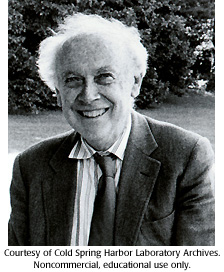
James Watson and Francis Crick solved the structure of DNA. Other scientists, like Rosalind Franklin and Maurice Wilkins, also contributed to this discovery.
JAMES DEWEY WATSON (1928-)
James Watson was born in Chicago. As a child, he was bright and inquisitive. One of his favorite words was "why?" and he wasn't satisfied with simple answers. He accumulated a lot of knowledge by reading the World Almanac, and won $100 as a "Quiz Kid" on a popular radio program. He used this money to buy binoculars for bird-watching ? a serious hobby for himself and his father. Watson entered the University of Chicago at 15 under the gifted youngster program. He did well in courses that interested him, like biology and zoology, and not as well in other courses. He decided that he would go to graduate school and study to become the curator of ornithology at the Museum of Natural History. In his senior year at Chicago, Watson read Erwin Schrödinger's book: What is Life? The Physical Aspect of the Living Cell. He was fascinated by the idea that genes and chromosomes hold the secrets of life. When Watson went to do a Ph.D. with Salvador Luria, a pioneer in bacteriophage research, at Indiana University, it seemed the perfect opportunity to work on some of these problems. After his Ph.D. in 1950, Watson spent time in Europe, first in Copenhagen and then at the Cavendish Laboratory of the University of Cambridge. By now, Watson knew that DNA was the key to understanding life and he was determined to solve its structure. He was lucky to share an office with Francis Crick, a Ph.D. student who was also interested in the structure of DNA. Although both were supposed to be working on other projects, in 1953, they built the first accurate model of DNA ? one of the great scientific advances of all time. In 1962, Watson shared the Nobel Prize for Physiology or Medicine with Francis Crick and Maurice Wilkins who, with Rosalind Franklin, provided the data on which the structure was based. Watson wrote The Double Helix: A Personal Account of the Discovery of the Structure of DNA, which was published in 1968. This book was the first of its kind, being a gossipy account of the inner workings of the scientific world, and has never been out of print. In 1956, Watson accepted a position in the Biology department at Harvard University where the focus of his research was RNA and its role in the transfer of genetic information. Although he continued to be a member of the Harvard faculty until 1976, Watson took over the directorship of Cold Spring Harbor Laboratory in 1968. Watson has had a long association with Cold Spring Harbor Lab. Salvador Luria and Max Delbrück taught a popular summer course on phage genetics, and during his graduate days, Watson enjoyed this "summer camp" for scientists. Watson has made Cold Spring Harbor Laboratory one of the world's premier research facilities for cancer, neurobiology, and basic molecular genetics. Currently, Watson is the President of Cold Spring Harbor Laboratory. Watson has played a significant role in the development of science policy, from the War on Cancer, through the debates over the use of recombinant DNA, to promoting the Human Genome Project. From 1988 to 1992, he ran the Human Genome Project at the National Institutes of Health while still directing Cold Spring Harbor Laboratory. One of his major interests is education. His first textbook, Molecular Biology of the Gene, set new standards for biology textbooks, and it was followed by Molecular Biology of the Cell, and Recombinant DNA. He is actively exploring the avenue of multimedia education and the WWW through projects being developed at the DNA Learning Center, the educational arm of Cold Spring Harbor Laboratory. He was and is one of the main motivators of this project, DNA from the Beginning. Watson has been described by many as brilliant, outspoken and eccentric. He is energized by intelligent people and doesn't suffer fools. Watson is an avid tennis player and has been ever since his grad school days. He still tries to play tennis every day. FRANCIS HARRY COMPTON CRICK (1916-2004)
Francis Crick was born in a small town near Northampton, England. As a child, Crick was very inquisitive and he read all of the books of Children's Encyclopedia that his parents bought him. He found the sections that dealt with science most interesting. This interest led to "kitchen" experiments and eventually serious study and a second-class Honours degree in physics at University College, London. The physics Crick learned in class was already out of date, so he taught himself the rudiments of quantum mechanics while doing graduate research on the viscosity of water. World War II interrupted his graduate studies. During the war, Crick worked for the Admiralty doing mostly research and design on magnetic and acoustic mines. When the war ended, Crick continued to work at the Admiralty but he knew he did not want to design weapons for the rest of his life. The problem was that he was unsure what he did want to do. In the end, he decided to enter the life sciences. He liked reading, thinking, and talking about the new discoveries being made in the life sciences. Crick found that "what you are really interested in is what you gossip about." To pursue his interests, Crick visited several labs and scientists. He finally settled in for a two year stint at Strangeways Laboratory where he did work on the effects of magnetism on chick fibroblast cells. In 1947, armed with this biology experience, Crick joined Max Perutz at the Cavendish Laboratory in Cambridge. Sir Lawrence Bragg was directing a new unit of the Laboratory where they were using X-ray crystallography to study protein structure. Max Perutz was working on the structure of hemoglobin and Crick's thesis project was on X-ray diffraction of proteins. In 1951, Francis Crick met James Watson who was visiting Cambridge. Although Crick was twelve years older, he and Watson "hit it off immediately." Watson ended up staying at Cavendish, and using available X-ray data and model building, the two solved the structure of DNA. The classic paper was published in Nature in April 1953. A flip of the coin decided the order of the names on the paper. Francis Crick, James Watson and Maurice Wilkins shared the 1962 Nobel Prize for Physiology or Medicine for solving the structure of DNA. Maurice Wilkins and Rosalind Franklin provided some of the X-ray crystallographic data. After the "double helix" model, there were still questions about how DNA directed the synthesis of proteins. Crick and some of his fellow scientists, including James Watson, were members of the informal "RNA tie club," whose purpose was "to solve the riddle of RNA structure, and to understand the way it builds proteins." The club focused on the "Central Dogma" where DNA was the storehouse of genetic information and RNA was the bridge that transferred this information from the nucleus to the cytoplasm where proteins were made. The theory of RNA coding was debated and discussed, and in 1961, Francis Crick and Sydney Brenner provided genetic proof that a triplet code was used in reading genetic material. For most of his career, Crick was at Cambridge working for the Medical Research Council. In 1976, Crick moved to the Salk Institute in La Jolla where he focused his research on developmental neurobiology. In 1988, he wrote about his experiences in What Mad Pursuit: A Personal View of Scientific Discovery. Crick has been described as having a keen intellect and a dry, British sense of humor. ROSALIND ELSIE FRANKLIN (1920-1958)
Rosalind Franklin was born in London, England. Her family was well-to-do and both sides were very involved in social and public works. Franklin's father wanted to be a scientist, but World War I cut short his education and he became a college teacher instead. Rosalind Franklin was extremely intelligent and she knew by the age of 15 that she wanted to be a scientist. Her father actively discouraged her interest since it was very difficult for women to have such a career. However, with her excellent education from St. Paul's Girls' School ? one of the few institutions at the time that taught physics and chemistry to girls ? Franklin entered Cambridge University in 1938 to study chemistry. When she graduated, Franklin was awarded a research scholarship to do graduate work. She spent a year in R.G.W. Norrish's lab without great success. Norrish recognized Franklin's potential but he was not very encouraging or supportive toward his female student. When offered the position as an assistant research officer at the British Coal Utilization Research Association (CURA), Franklin gave up her fellowship and took the job. CURA was a young organization and there was less formality on the way research had to be done. Franklin worked fairly independently, a situation that suited her. Franklin worked for CURA until 1947 and published a number of papers on the physical structure of coal. Franklin's next career move took her to Paris. An old friend introduced her to Marcel Mathieu who directed most of the research in France. He was impressed with Franklin's work and offered her a job as a "chercheur" in the Laboratoire Central des Services Chimiques de l'Etat. Here she learned X-ray diffraction techniques from Jacques Mering. In 1951, Franklin was offered a 3-year research scholarship at King's College in London. With her knowledge, Franklin was to set up and improve the X-ray crystallography unit at King's College. Maurice Wilkins was already using X-ray crystallography to try to solve the DNA problem at King's College. Franklin arrived while Wilkins was away and on his return, Wilkins assumed that she was hired to be his assistant. It was a bad start to a relationship that never got any better. Working with a student, Raymond Gosling, Franklin was able to get two sets of high-resolution photos of crystallized DNA fibers. She used two different fibers of DNA, one more highly hydrated than the other. From this she deduced the basic dimensions of DNA strands, and that the phosphates were on the outside of what was probably a helical structure. She presented her data at a lecture in King's College at which James Watson was in attendance. In his book The Double Helix, Watson admitted to not paying attention at Franklin's talk and not being able to fully describe the lecture and the results to Francis Crick. Watson and Crick were at the Cavendish Laboratory and had been working on solving the DNA structure. Franklin did not know Watson and Crick as well as Wilkins did and never truly collaborated with them. It was Wilkins who showed Watson and Crick the X-ray data Franklin obtained. The data confirmed the 3-D structure that Watson and Crick had theorized for DNA. In 1953, both Wilkins and Franklin published papers on their X-ray data in the same Nature issue with Watson and Crick's paper on the structure of DNA. Franklin left Cambridge in 1953 and went to the Birkbeck lab to work on the structure of tobacco mosaic virus. She published a number of papers on the subject and she actually did a lot of the work while suffering from cancer. She died from cancer in 1958. In 1962, the Nobel Prize in Physiology or Medicine was awarded to James Watson, Francis Crick, and Maurice Wilkins for solving the structure of DNA. The Nobel committee does not give posthumous prizes. MAURICE HUGH FREDERICK WILKINS (1916-2004)Maurice Wilkins was born in Pongaroa, New Zealand. His father was a doctor and in order to pursue his interest in preventative medicine, moved the family to England when Wilkins was six. Wilkins believes that having spent his formative years in New Zealand, he was imbued with the exploratory and adventuresome nature of the early settlers - traits that proved useful in his career as a scientists. In 1938, Wilkins graduated with a physics degree from St. John's college in Cambridge. Since England was at war, scientists especially physicists were in great demand. Wilkins worked with John Randall at Birmingham University on improving the radar. This earned him a Ph.D. in 1940, and some of Wilkins work is still used in today's radar. In 1943, the physics department at Birmingham University, Wilkins included, moved to Berkeley, California to work on the Manhattan Project. At the time, it was all part of the war effort. However, after the devastating effects of the atomic bomb at Hiroshima and Nagasaki, Wilkins became and continues to be an opponent against nuclear weapons. After the war, Wilkins was hired as a physics lecturer at St. Andrews' University. Here, he again met with John Randall, now Sir John, who wanted to use physics to study biological problems. Randall was offered a full professorship at King's College in London and there he set up a biophysics lab with Wilkins as one of his members of the Medical Research Council Biophysics Research Unit. Wilkins studied biological molecules like DNA and viruses using a variety of microscopes and spectrophotometers. He eventually began using X-rays to produce diffraction images of DNA molecules. The X-ray diffraction images produced by him, Rosalind Franklin, and Raymond Gosling led to the deduction by James Watson and Francis Crick of the 3-dimensional helical nature of DNA. Wilkins shared the 1962 Nobel Prize in Physiology or Medicine with Watson and Crick. Wilkins was made a Companion of the British Empire in 1962 and has won other awards and prizes for his work. He collected sculptures and was fond of gardening. |
|
|