Concept 12 Evolution begins with the inheritance of gene variations.

 Charles Darwin changed the world with his theory of evolution. This theory also provided the impetus for scientists to reexamine the question of heredity and inheritance, leading to the rediscovery of Mendel's laws and the evolution of the field of genetics. George Shull worked at the Station of Experimental Evolution. He used genetics to improve agricultural yields in corn and other crops.
Charles Robert Darwin (1809-1892)
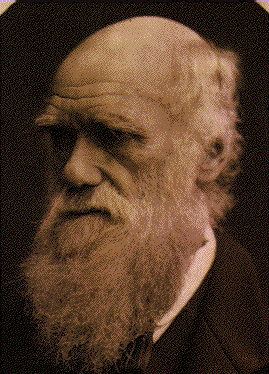
Charles Darwin was born in Shrewsbury, England. Charles Darwin's grandfather was the naturalist, philosopher and doctor Erasmus Darwin, who had published a four volume treatise containing his own views on the development of the species. Charles Darwin's father was also a physician, and wanted his son to carry on the family tradition. At 16, Darwin was sent to Edinburgh University to study medicine. Darwin was more interested in his zoology and geology classes. Eventually, his father withdrew him from Edinburgh and sent him to Cambridge to study divinity.
In 1831, Darwin was invited by Captain Fitz-Roy to be the science officer on the H.M.S. Beagle on an exploratory survey. During the next five years, the Beagle toured the South American coasts, the Galapagos Islands, New Zealand, Australia and South Africa. The voyage was an eye-opening experience for Darwin. He collected, sketched and made notes of fossils, and a wide assortment of living organisms. Based on what he saw, Darwin believed that life evolved, and could be traced through fossils and living examples. In this he was influenced by what he knew of geology and the stratification of rock layers. Darwin concluded that the adaptations and changes in many of the species he saw, especially the finches and tortoises on the Galapagos Islands, came about through a process of natural selection.
On his return to England in 1836, Darwin did not immediately publish his theory on evolution. He spent time sorting and cataloguing his collection of material, and publishing popular accounts of his voyage on the Beagle. In 1857, a young biologist, Alfred Russel Wallace, sent Darwin a letter outlining the "theory of evolution through natural selection." Wallace wanted Darwin's opinion and possible endorsement for presentation of the theory to the Linnean Society of naturalists. Darwin recognized the similarity of his work to Wallace's, and actually offered to burn his own work to avoid being thought of as an idea stealer. In the end both Darwin and Wallace presented the theory to the Linnean Society. It was Darwin's book however, On the Origin of Species, published in 1859, which garnered all the attention and the controversy. The book had a profound impact on the social, religious, political and scientific thinking of the general public and the scientific community. Darwin himself was uncomfortable with all the controversy and avoided it whenever possible.
Darwin wrote and published books and papers on other subjects relating to natural history, The Variation of Animals and Plants under Domestication (1868), The Descent of Man (1871). Darwin never forgot Wallace's contributions to the natural selection theory. Darwin died in 1882 and is buried in Westminster Abbey.


Charles Darwin's maternal grandfather was Josiah Wedgwood (1730-1795) who founded the famous Wedgwood Pottery company.

If evolution is an adaptation of a species to its environment, why do "bad" traits still exist?
 Children resemble their parents.
 Genes come in pairs.
 Genes don't blend.
 Some genes are dominant.
 Genetic inheritance follows rules.
 Genes are real things.
 All cells arise from pre-existing cells.
 Sex cells have one set of chromosomes; body cells have two.
 Specialized chromosomes determine sex.
 Chromosomes carry genes.
 Genes get shuffled when chromosomes exchange pieces.
 Evolution begins with the inheritance of gene variations.
 Mendelian laws apply to human beings.
 Mendelian genetics cannot fully explain human health and behavior.